Vision
By supporting employee job satisfaction and individual growth, we will build a foundation to encourage employees to act independently to drive transformation.
Changes in the external environment and the idea that “every employee plays an active role”
The diversification of work styles and decline in the working-age population have sparked intensified competition among companies to secure human resources. In addition, the accelerating population mobility is inducing people to seek more flexible work arrangements and diverse career choices, changing also values regarding work styles. Amidst these drastic changes in the external environment, the Futaba Group aims to be a group of companies that grow together with their employees. This involves encouraging individual employees to learn and grow and enhancing our organizational capability to leverage their strengths, thereby increasing job satisfaction. To achieve this, we embrace the basic idea that “every employee plays an active role.” To align the management and business strategies with the human resources strategy, we have defined the “human resources required to achieve our management and business strategies.” By advancing a “human resources management reform” to accelerate initiatives for recruiting, fostering and placing the great diversity and variety of people and a “personnel system reform” to develop systems and culture to support that, we will enable all employees to grow and thrive, which will lead to achieving the medium-term management plan and our Purpose of “producing environmentally-friendly products, we will help create a comfortable society for all people.” We believe that this cycle is what corporate growth is about, and a driving force that enables people to grow again and again.
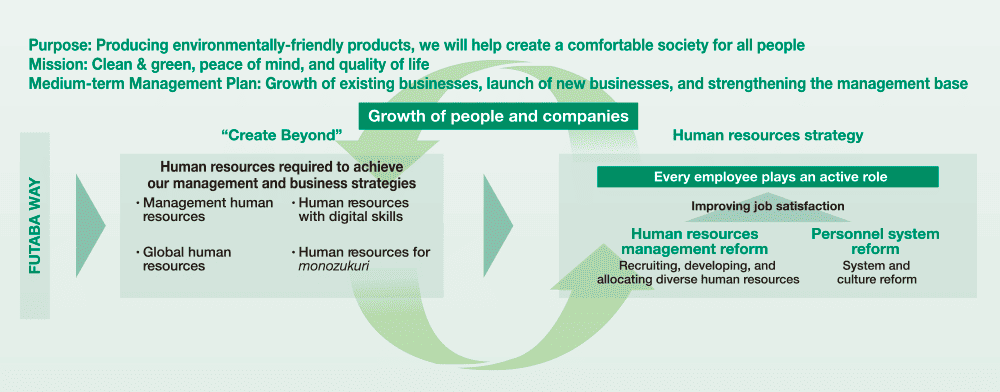
Overview of the review process of human resources strategy
To secure and maintain the human resources needed to bring our strategy to fruition, we will identify human resources issues, and study and implement measures to resolve them through the following processes.

Human resources management reform: Recruiting, developing, and allocating diverse human resources
A key element for enabling every employee to play an active role is that every one of our diverse employees thinks and acts independently on their own, experiencing their own growth with job satisfaction. In 2023, we determined that we will foster and strengthen management human resources, global human resources, human resources with digital skills, and human resources for monozukuri as the human resources essential for achieving our management and business strategies. To maintain and acquire human resources meeting these visions, Futaba Industrial holds monthly Human Resources Strategy Committee meetings to conduct discussions based on the steps described above for the recruitment and development of diverse talent regardless of gender, nationality, age, or other factors. The meetings involve vigorous discussions from the perspectives of all executives, including the President, on a wide range of topics including employee development and career support, global position management, resource management, organizational culture reform, and promoting women’s advancement.
Personnel system reform: Reforming the system and culture that support human resources management
In the past, Futaba Industrial had a culture of relying on long working hours to support its business with lack of interest in reforming work processes. There was also reluctance to invest time in medium- to long- term human resource development or activities not directly linked to revenue generation, disregarding their value. This, regrettably, resulted in a declining sense of ownership, which hindered us from fully leveraging the strengths and capabilities of our diverse human resources. In light of this, recognizing that reforming the workplace environment and culture is essential to enable each employee to maximize their potential and to foster human resources willing to take up challenges in the era of volatility, uncertainty, complexity, and ambiguity (VUCA), we have initiated a personnel system reform. We believe that when employees enjoy a good work-life balance and work in a culture of mutual respect, their job satisfaction increases, enabling every employee to play an active role.
KPIs to increase Futaba’s corporate value (non-consolidated)
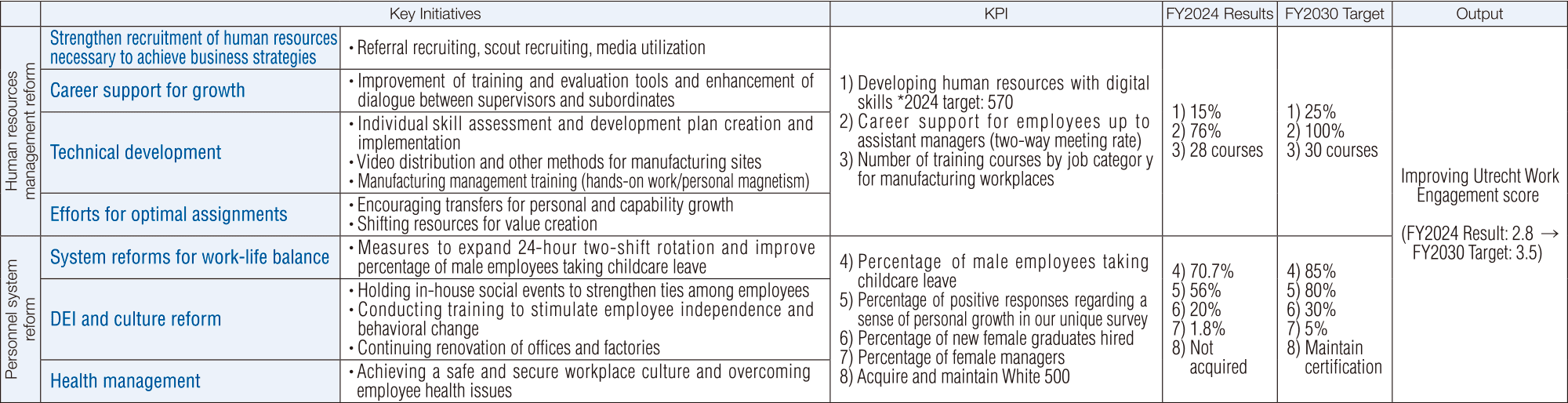
Framework and approach to promoting human resources strategy
Human Resources Strategy Committee
To bring our human resources strategy to fruition, the Human Resources Strategy Committee—with top management in attendance—shares specific issues and measures, and monitors progress. These activities are spearheaded by the CSO, in cooperation with the site heads of domestic and overseas Group companies and their respective human resource departments.
Under the Human Resources Strategy Committee, Succession Committees and the Personnel System Reform Promotion Committee have also been established to promote initiatives in their areas of responsibility. Succession Committees have been respectively established at the global, regional, and site levels to study and promote human resources development plans tailored to the unique conditions and issues of each region and site. The Personnel System Reform Promotion Committee discusses progress and issues related to all policies.
Strengthening human resources management to enhance global governance
- The Futaba Group operates a Global Succession Committee (GSC), which comprises members from Center Chiefs of the headquarters in Japan and above. The GSC promotes the selection and development of human resources to fill key positions related to global governance, as well as the organizational structure most appropriate for groupwide management. Moreover, Regional Succession Committee (RSC) and Local Succession Committee (LSC) meetings are held in each region with senior management from each company participating as members to formulate and execute succession plans for each of the companies and to systematically develop local human resources. The contents of the RSC and LSC discussions are shared with the GSC to systematically promote local personnel to key positions.
-