



Basic approach
The Futaba Group positions the promotion of DE&I as one of its key management strategies aimed at achieving sustainable growth. In accordance with our Diversity, Equity & Inclusion Statement, we will actively strive to further expand and improve our systems and change the mindset of employees as we aim for the “every employee plays an active role” in which each individual can leverage his or her strengths and feel motivated as they challenge themselves and actively participate.
- Diversity, Equity & Inclusion(DEI) Statement
-
- We will value differences among individuals in gender, age, race, nationality, disability, sexual orientation, religion and belief, values,workstyle, lifestyle, background, and others, and consider their diversity the driving force for new value creation and growth.
- By offering support and consideration tailored to the individual, we provide everyone with a fair opportunity to challenge themselves.
- We will strive to create work environments in which employees respect and appreciate each other's personality and mutually enhance one another, thereby enabling teams to produce best outcomes.
- As a global monozukuri company with leading technologies, we will offer solid value in terms of the clean & green, peace of mind, and quality of life to more people around the world through our diverse people that enhance their creativity and ability to take action and that take initiative.
Initiatives to revitalize the organizational culture
We believe that an environment in which diverse human resources are respected, fairly supported, and can work in their own way with peace of mind is indispensable for realizing a state where every employee plays an active role. Based on this DEI concept, the following efforts are being made to revitalize the organizational culture.
Promotion of DEI
In FY2024, as in FY2023, we continued to flatten our organization by advancing the hot-desking system for offices as a measure to promote awareness of D (diversity) and I (inclusion). In addition, unconscious bias training and diversity management training were newly conducted for managers. We transformed managers’ mindsets toward a more open workplace culture and provided them with the opportunity to change their behavior. In addition, we have enhanced our benefit systems by granting a certain number of points (subsidies) to employees for the cafeteria plan introduced from the viewpoint of E (equity), and employees can select and use the subsidies they wish to receive from the cafeteria plan menu.
Improvement of employee initiative
In FY2024, we carried out Responsibility Mindset Training*. The aim of this training is to increase the number of employees who have a proactive mindset, thinking and acting on what they can do to achieve their goals, breaking away from an attitude of maintaining the status quo and blaming others. We will continue this training program in FY2025 to promote a change in individual mindsets and foster an organizational culture in which each individual maintains a sense of responsibility.
*The training company responsible for this program was Achievement HR Solutions Corp
Creating workplaces with high psychological safety
In FY2024, we conducted activities for creating a model workplace with high psychological safety at the Mutsumi Plant. Many employees were inspired to take ownership of psychological safety, and with program benefits mainly manifesting at the line manager level. Due to strong demand from participating workplaces, the program has been extended from its initial six months and is ongoing. Based on these results, we will expand the number of target workplaces in FY2025 and further promote the revitalization of the organizational climate.
-
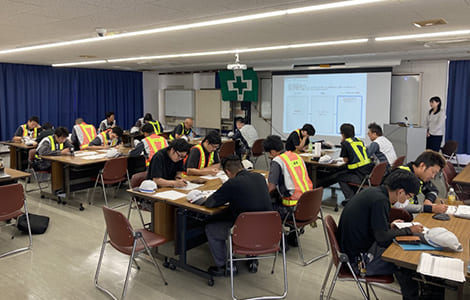
Group training on psychological safety
-
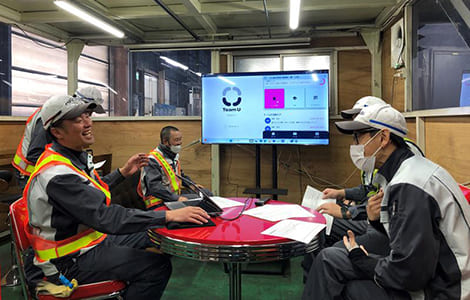
Activities for creating workplaces with high psychological safety
Grassroots Activities
In FY2024, we conducted face-to-face interviews with 153 employees, regardless of job type, about their actual workplace conditions with the aim of improving employee job satisfaction. Within these interviews, there was significant feedback about career development, and our analysis showed a correlation with work engagement. Therefore, career development was identified as a priority issue, and we are working to enhance career dialogue and vitalize job rotations as priority action items in our FY2025 corporate policy. As each individual considers their own career, their manager will work with them on a one-on-one basis to achieve optimal placement in the right position, leading to the employee's growth.
Female empowerment initiatives
In recognition of the results of our efforts to develop a system and environment that allows female employees to work flexibly after life events, we received “Kurumin” certification as a company supporting childcare by the Ministry of Health, Labour and Welfare in May 2024. In January 2025, we received the Family Friendly Company Award from Aichi Prefecture as a company that is implementing excellent initiatives that serve as a model for others. Going forward, we will continue to strive to achieve KPIs such as the percentage of female managers, recruitment target for new graduates, and rate of male employees taking childcare leave to further empower female employees, as well as to create a workplace environment in which everyone can feel job satisfaction in their work.
Initiatives for promoting female employees to managers
We are promoting the systematic training and promotion of female employees to management positions, with the goal of achieving a percentage of female managers of 5% or more by 2030. Since the current management positions are disproportionately located in the Head Office divisions and female employees have few role models close to them, backup for their development needs to be provided from a company-wide perspective. To address this issue, in FY2024, we worked to create a company-wide integrated development system to achieve our goals. This included participation in external seminars to encourage interaction with female management candidates at other companies, creation of individual career plans for each center to provide opportunities and development for women, and sharing of career and development plans at the Human Resources Strategy Committee.
Percentage of female managers and executives(non-consolidated)
| FY | 2021 | 2022 | 2023 | 2024 | 2025 Target |
|---|---|---|---|---|---|
| Female executives* | 7.7% | 7.7% | 9.1% | 18.2% | - |
| Female managers | 0.9% | 1.1% | 1.3% | 1.8% | 3.0% |
*Executives:Director, Audit & Supervisory Board Member
Percentage of new female graduates(on career track; non-consolidated)
| FY | 2021 | 2022 | 2023 | 2024 | 2025 Target |
|---|---|---|---|---|---|
| Percentage | 11.9% | 12.5% | 19.4% | 20.0% | 20.0% |
Initiatives to create a fulfilling working environment and enhance employee development
-
In FY2024, we launched Will Cafe, a roundtable discussion to share concerns about career development and work-life balance. The purpose of this meeting is to discover new ways of working through role models and to deepen connections among employees. This meeting was a valuable opportunity to exchange views on actions to empower female employees. In January 2025, we invited Managing Director Ord and Deputy Managing Director Garvey from FMUK, our European Group company, to share their ideas and innovations on work-life balance in Europe. In FY2025, this initiative will be expanded to all employees, regardless of gender or job type, and based on feedback obtained through the Cafe, we will consider and promote measures.
-
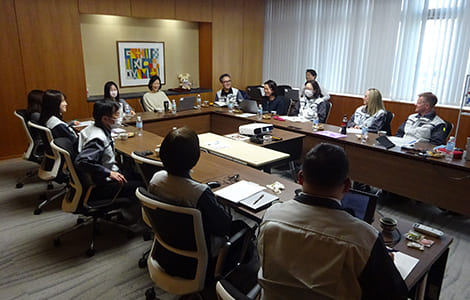
A conversation at Will Cafe
Initiatives to eliminate the gender pay gap
If the pay level of male employees at Futaba were set at 100, then the pay level of female employees would be 72. Although we use the same pay structure for men and women, a gender pay gap does exist due to differences such as staff composition, types of occupation, rank, and ways of working. In particular, the fact that the percentage of female managers is lower than that of men is the main factor behind the pay gap between men and women. In order to increase the percentage of female managers, each employee and their supervisor review their individual career plans according to their life stage every year, and systematically advance their careers to become managers.
Recruitment initiatives
To hire diverse people on a global basis regardless of gender, nationality, age, or other attributes, we provide interviewer training so that applicants are assessed from fair, equal, and objective perspectives. Regarding the recruitment of new graduates, we are strengthening recruitment in the fields of agriculture, science, and engineering, and actively providing employment support, etc. in cooperation with local chambers of commerce. With regard to mid-career hiring, we actively conduct referral hiring and communication to various media outlets to acquire diverse personnel who bring new knowledge, values, and ideas to the Company.
Percentage of mid-career hires(non-consolidated)
| FY | 2020 | 2021 | 2022 | 2023 | 2024 |
|---|---|---|---|---|---|
| Percentage | 23.1% | 27.1% | 26.3% | 27.5% | 36.0% |
Percentage of temporary workers becoming regular employees(non-consolidated)
| FY | 2020 | 2021 | 2022 | 2023 | 2024 |
|---|---|---|---|---|---|
| Percentage | 76.7% | 73.0% | 95.2% | 73.3% | 88.2% |
Initiatives for reemployment after mandatory retirement
-
Futaba has a system for rehiring employees after their mandatory retirement to offer them an opportunity to work and pass on their technical capabilities and skills to the next generation. In compliance with laws and regulations, we rehire all those who wish to be re-employed. We reviewed the system to treat rehired employees according to their roles so that they can find their jobs fulfilling after their mandatory retirement, with a view to Japan’s declining workforce due to the aging population and lower birth rate. We are also promoting other initiatives, such as holding seminars that teach employees how to build assets at life milestones and health seminars that teach them how to stay healthy, providing physical fitness testing in order to raise awareness of career building and staying healthy during years of service before retirement and to encourage employees to work in better condition for many years to come. Another is establishing universal lines (low-workload production lines) for elderly and female employees to work in an easier way.
-
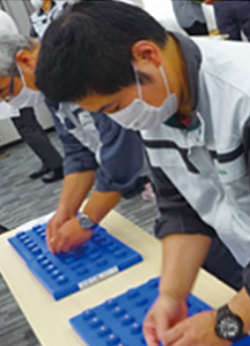
Manual dexterity test
Number of rehired employees over time (non-consolidated)
| FY | 2020 | 2021 | 2022 | 2023 | 2024 |
|---|---|---|---|---|---|
| Number of rehired employees | 138 | 131 | 168 | 186 | 197 |
*The number of rehired employees is the number of people registered with us aged 60 to 65 at the end of each fiscal year
Initiatives for hiring people with disabilities
-
Futaba works proactively to hire people with disabilities in support of their independence and participation in society. With an employment rate of 2.79% in FY2024, we continue to exceed the statutory requirement of 2.5%. We provide training programs to improve understanding at the workplaces that people with disabilities will belong to, and they have an interview with the Human Resources Division on an individual basis, in order to improve their work environments.
-

Workplace environment for people with disabilities