Basic approach
At Futaba, we are working to create a workplace in which every employee can continue to work with peace of mind and longevity, in good mental and physical health. By supporting flexible work styles according to one's own life stage, we have created an environment where each individual can realize their fullest potential while feeling a sense of job satisfaction.
Status of total working hours
The target (company-wide average) for total annual working hours in FY2025 has been set at 1,950 hours (20 days of annual paid leave per year and less than 20 hours of overtime work per month), and efforts are made to promote the use of annual paid leave and to reduce overtime work. To reduce total working hours, we will review our business processes and promote operational efficiency by utilizing DX and AI tools.
Average number of days taken as paid annual leave(union members on a non-consolidated basis)
| FY | 2020 | 2021 | 2022 | 2023 | 2024 |
|---|---|---|---|---|---|
| Days | 17.9 | 19.4 | 18.6 | 18.5 | 18.4 |
Monthly average overtime hours(union members on a non-consolidated basis)
| FY | 2020 | 2021 | 2022 | 2023 | 2024 |
|---|---|---|---|---|---|
| Hours | 20.4 | 21.4 | 19.3 | 21.2 | 21.3 |
Work-life balance support systems of work and childcare
/ nursing care
Flexible work and leave systems are in place to allow employees to choose the way of working that best suits their lifestyles during their parenting years. In addition to enhancing these systems, we are also implementing activities to build understanding among managers, creating a workplace where it is easier to gain the understanding and cooperation of those around them. We will promote the development of a comfortable working environment for employees in the parenting years, regardless of gender, and aim to increase the ratio of male employees taking childcare leave to 85% by FY2030.
| Childbirth/Childcare | Nursing care | |||||||
| From pregnancy to childbirth | One year old | Two years old | Three years old | Entry to elementary school | Completion of sixth grade | Completion of the third year of high school | ||
| Long-term leave |
Spouse
maternity leave Maternity leave before and after childbirth
Childcare leave |
Nursing care temporary leave
|
||||||
| Leave |
Child nursing leave |
Child school event leave Anshin leave *No age limit for children.
Childcare Support Leave |
Nursing care leave
Anshin leave
|
|||||
| Work |
Exemption from overtime work Exemption from late-night work Telecommuting system *No age limit for children Flextime system(no core time)*No age limit for children |
Shorter work hours |
Shorter work hours
Restrictions on overtime work
Exemption from late-night work
Telecommuting system
Flextime system
(no core time) |
|||||
Details of the main work-life balance support systems
| System | Details |
|---|---|
| Childcare leave | Employees can take leave until their child reaches two years old. |
| Shorter work hours for childcare | Designated work hours per day can be reduced by a maximum of two hours until the end of March when the employee's child completes the sixth grade of elementary school(flextime work is also possible) |
| Nursing care temporary leave | A total of 365 days can be taken per eligible family member(leave can be split into three installments) |
| Shorter work hours for nursing care | Leave can be taken any number of times in the three years from initial use of the system for each eligible family member |
| Anshin leave | A maximum of 20 days of expired annual paid leave can be accrued and used for personal injury or illness, nursing, childcare and nursing care |
| Telecommuting system | Employees in indirect divisions can work all day or part of the day at home |
Rates of taking childcare leave (union members on a non-consolidated basis)
| FY | 2020 | 2021 | 2022 | 2023 | 2024 |
|---|---|---|---|---|---|
| Men | 6% | 11% | 35% | 66% | 71% |
| Female | 86% | 95% | 121% | 79% | 125% |
* The percentages may exceed 100% because female employees and/or spouses of employees who had given birth in a prior fiscal year took childcare leave during the current fiscal year. In FY2023, 100% of female employees who gave birth in that fiscal year took childcare leave. However, if a woman gave birth at the end of FY2023, she would be counted as a person who took childcare leave in FY2024. Therefore, the percentage of women who took childcare leave was below 100%.
Improving employee engagement
Group companies in North America and China conduct a shared engagement survey to measure the results of various personnel policies. This marks the third year in FY2024, with 2,224 respondents in North America and 1,218 in China. The response rate has been improving year by year (FY2023: 81%, FY2024: 89%). In North America, four out of five sites improved their scores by steadily implementing measures (such as improving work-life balance and establishing clinics within sites) in line with the issues faced by each site. In April 2025, one more company has appointed a national staff member (locally hired employee) as President of a local subsidiary, which will further promote management aligned with employee values and improve engagement throughout the North American region. Though scores declined slightly in China for FY2024, but this can be partly attributed to the market being in a transitional period, including a rapid shift to electrification. However, there are some positive signs in the business, such as orders for parts production from a new customer in China. Going forward, we will share business strategies with our employees and work with them to create a vision for the future, thereby increasing their engagement. In Japan, employee job satisfaction is considered to be closely related to corporate performance, and we have been conducting our own survey of all non-consolidated employees since FY2023, including questions on engagement (sense of belonging to the organization) and work engagement (motivation related to work), with the aim of improving employee job satisfaction. The Work Engagement score, which indicates job satisfaction, increased from 2.7 in FY2023 to 2.8 in FY2024. We believe that one factor in this improvement is our work to revitalize the organizational culture (color unification of lanyards, encouraging the use of “san (honorific suffix)” instead of job titles, and training with original educational videos on psychological safety). In FY2024, in addition to accelerating the penetration of DEI, based on our analysis of the diversity of issues faced by each workplace, we promoted measures to improve job satisfaction tailored to each current situation at each center. In FY2025, we will further deepen these efforts and introduce the Work Engagement score as a management indicator common to the Group in Japan and overseas in order to enhance the job satisfaction of all employees, regardless of country or region.
Engagement score*
-
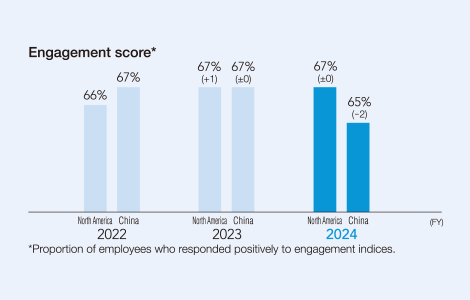
*Proportion of employees who responded positively to engagement indices.
-
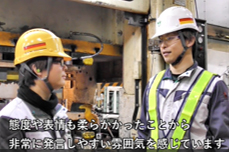
The Company’s original awareness-raising video
Labor-management relations
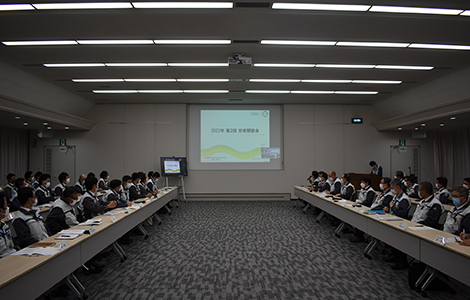
We have built sound and fair labor-management relations aimed at corporate prosperity and improvement of job satisfaction and work comfort based on mutual trust and responsibility between labor and management. In terms of communication between labor and management, we provide opportunities for labor and management to hold honest dialogue, such as labor-management consultation(once a year), labor-management meetings(twice a year), and plant meetings(monthly) held at each plant.