



Support for the Task Force on Climate-related Financial Disclosures(TCFD)recommendations and information disclosure
Futaba declared its support for the TCFD recommendations in June 2022. Based on the TCFD framework, we conducted a scenario analysis, identified risks and opportunities that could impact our business activities, and incorporated countermeasures in our management strategies. We will look into the impact of the risks and opportunities on our financial results and expand and improve our activities.
Governance
-
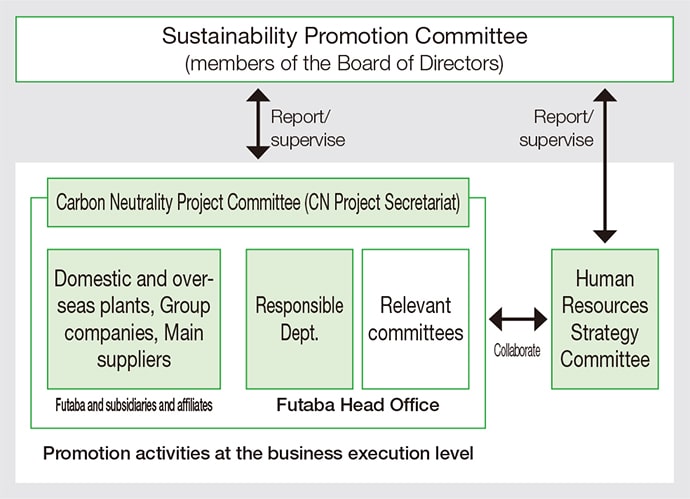
At Futaba, the CN Project Secretariat reports our management approach to climate change and the risks and opportunities associated with our business to the Board of Directors. As one of the Company’s priority issues, environmental issues including climate change are incorporated into the medium-term management plan and corporate global policy after approval by the Board of Directors, and the Company is working to achieve its goals. The Carbon Neutrality Project Committee deliberates and establishes the Futaba Group’s policies and targets, and each responsible department formulates action plans, deploys them to the Futaba Group, and manages their progress globally. In addition, we have expanded this to our suppliers in Japan, and are promoting measures throughout the supply chain. Progress is reported to the Board of Directors, while improvement activities and the reexamination of targets based on changes in the business environment and business performance are discussed by the CN Project Secretariat and each responsible department, and are reflected in the policies and targets.
-
Promotion system chart
Strategy
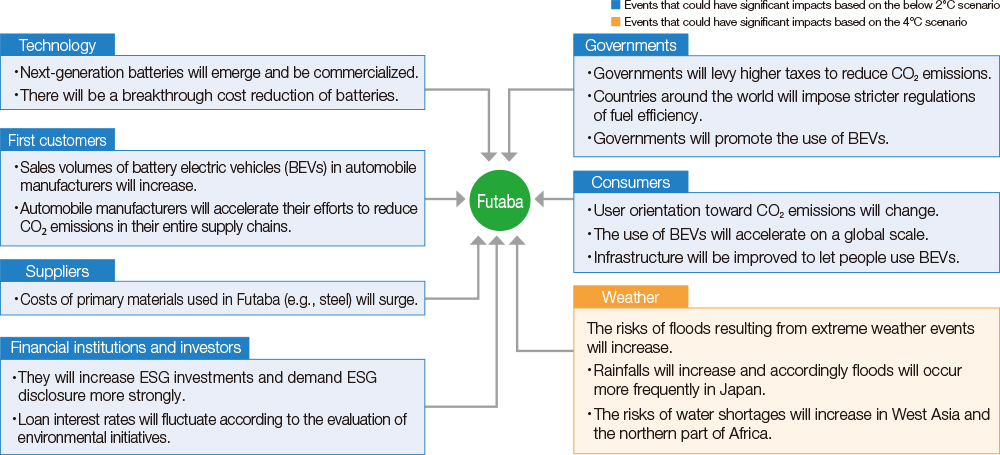
We conducted a scenario analysis to understand the risks and opportunities brought about by climate change and the impacts of them and to examine the appropriateness of a strategy predicting what the world will look like around 2030 and whether we need to implement more initiatives.
With reference to several existing scenarios published by the International Energy Agency (IEA) and the Intergovernmental Panel on Climate Change (IPCC),*1 we assumed two worlds in the scenario analysis, the below 2°C scenario*2 and the 4°C scenario*3. The former scenario assumes the world with apparent transition impacts, and the latter scenario assumes the world with apparent physical impacts. The next page shows the landscape surrounding Futaba based on the scenarios, the risks and opportunities that could significantly impact Futaba, and measures against the risks and for the opportunities.
Furthermore, the Group began considering measures for the 1.5°C scenario based on the Sixth Assessment Report of the IPCC released in 2023 and the first GST*4 by COP28.
- *1 The IPCC was created in 1988 by the World Meteorological Organization (WMO) and the United Nations Environment Programme (UNEP).
- *2 Scenario assuming that countries around the world will take stricter policies and systems and that the increase in global average temperature at the end of the 21st century will be kept below 2°C above pre-industrial levels
- *3 Scenario assuming that countries around the world will not introduce additional policies and systems and that the global average temperature will rise 4°C or so above pre-industrial levels by the end of the 21st century
- *4 A system to understand the progress toward achieving the international targets set out in the Paris Agreement on climate change on a global scale
Landscape surrounding Futaba based on the scenarios
Risks and opportunities: events that could directly impact our net sales
| Events | Risks and opportunities | Impact | Measures | |
|---|---|---|---|---|
| Promotion of the use of BEVs and Evs (market) |
Transition risks (below 2°C scenario) |
|
Medium |
|
| Natural disasters and extreme weather events (acute) |
Physical risks (4℃ scenari) |
Decrease in net sales due to production delays and suspension caused by supply chain disruptions and sites stricken by natural disasters and extreme weather events |
― |
|
Risks and opportunities: events that could indirectly impact Futaba
| Events | Risks and opportunities | Impact | Measures | |
|---|---|---|---|---|
| Stricter CO2 emissions regulations (policies / laws and regulations) |
Transition risks (below 2℃ scenario) |
|
Low ↓ Medium |
|
| Public esteem (reputation) |
|
― |
|
|
Risk management
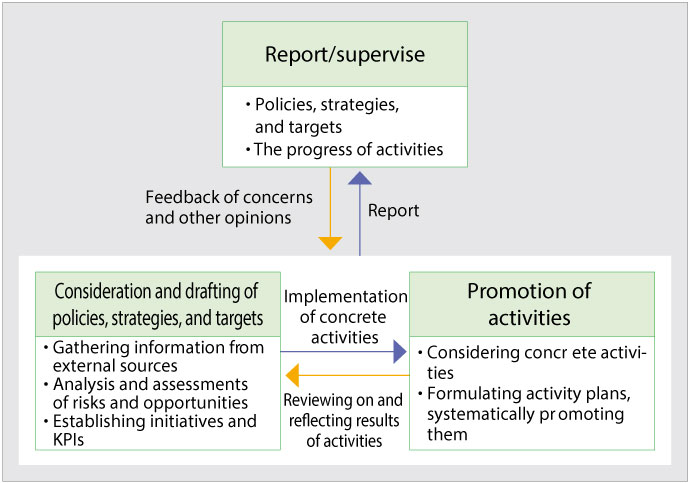
The Futaba Group identified climate-related risks based on the following process, and assesses and manages the risks.
-
How we identified risks
1. Selected high-priority social issues from both business and stakeholders' perspectives
2. Had external experts review the selected social issues
3. Interviewed departments involved and set a medium- to long-term target and management indicators related to the social issues including climate change
4. Reported to and obtained approval from management executives at the Sustainability Promotion Committee
-
Risk assessment and management
Metrics and targets
To manage the identified risks and opportunities, Futaba has set management indicators and strives to achieve the targets. In FY2024, in response to the release of the Sixth Assessment Report of the IPCC, we tightened the CO2 emission reduction targets for our plants to align with the 1.5°C scenario. In addition, the date for achieving carbon neutrality for the Japan segment has been moved up five years from 2035 to 2030.
Management indicators and FY2030 target as of May 2025
Targets for reduction of CO2 emissions and introduction rate of renewable energy
●Futaba Group
CO2 emissions reduction targets for plants (Scope1、2)
Global:
Reduction of 50% or more by FY2030 compared to FY2019 (Annual 4.6% reduction)
Japan segment:
Accepted challenge to achieve carbon neutrality by 2030
Introduction of renewable energy
Japan segment:
60% introduction in FY2030 (total electricity ratio, including credits)
Japan segment:
60% introduction in FY2030 (total electricity ratio, including credits)
●Suppliers
CO2 emissions reduction targets (Scope 1 and 2)
Major suppliers (127 companies):
Reduction of 50% or more by FY2030 compared to FY2019 (Annual 4.6% reduction)
Major suppliers (127 companies):
Reduction of 50% or more by FY2030 compared to FY2019 (Annual 4.6% reduction)
Management indicator results for 2024
CO2 emissions and introduction rate of renewable energy
●Futaba on a non-consolidated basis
Plant CO2 emissions:
40,302t-CO2
(Scope1, 2)
(29.7% reduction vs. FY2019)
(Scope1, 2)
(29.7% reduction vs. FY2019)
Introduction rate of renewable energy: 6%
●Suppliers
CO2 emissions:
22,567t-CO2
(Scope1, 2)
(-21.8% vs. FY2019)
(Scope1, 2)
(-21.8% vs. FY2019)