



Response to Carbon Neutrality(CN)
As measures to combat social issues such as extreme weather events sparked by global warming, we are striving to reduce CO2 emissions through comprehensive daily improvements in Scope 1 and 2 emissions, and we are steadily achieving results globally.
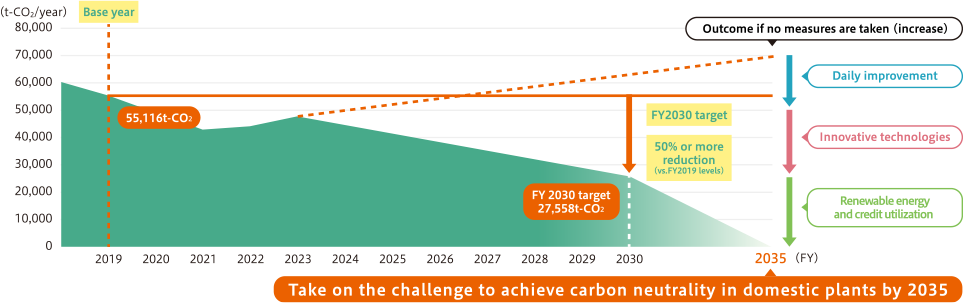
Following the release of the Sixth Report of the IPCC, we have tightened our CO2 emissions reduction targets for plants under the 1.5°C standard.
Furthermore, with regard to Scope 3 (upstream) emissions, we are focused on (1) raw materials--which account for the majority of Scope 3 CO2 emissions--and are actively working to mitigate CO2 emissions through product development that results in reduced usage while also improving the yield.
- CO2 emissions
reduction targets for plants
(Revised in October 2024*1) -
Non-consolidated and domestic and overseas Group companies: Reduction of 50% or more by FY2030 compared to FY2019 (Annual 4.6% reduction)
2035: Take on the challenge to achieve carbon neutrality in domestic plants*1 The reduction targets before the revision are as follows.
Non-consolidated: Reduction of 50% or more by FY2030 compared to FY2013 (Annual 3% reduction)
Domestic and overseas Group companies: Reduction of 33% or more by FY2030 compared to FY2019 (Annual 3% reduction)
2035: Take on the challenge to achieve carbon neutrality in domestic plants
Life Cycle CO2 Reduction
In addition to CO2 emissions reduction activities at our plants, we are implementing additional initiatives from a life cycle perspective.
- Upstream
-
Scope3
-

(1)Raw materials
-

(4)Transportation
/Delivery -

(7)Commuting
*Other:(2)Capital goods,(3)Fuel and energy-related activities not included in Scope 1 and 2,(5)Waste,(6)Business travel, and(8)Leased assets
-
Reduction of CO2 emissions in materials and parts
- Reduction of materials purchased through weight reduction utilizing technologies such as cold-stamped UHTSS for body parts
- Shift to eco-certified products(mufflers, exhaust manifolds, DPFs, and canisters)
- Collaboration and target setting with suppliers by rolling out our initiatives
Reduction of CO2 emissions related to distribution
- Enhancement of compatibility between suppliers and reinforcement of backup systems to optimize distribution considering regional characteristics
- Reduction in the number of die trials using CAE analysis to reduce the number of transpotrs
- Futaba
-
-
Scope1

Fuel combustion
-
Scope2

Use of electricity
-
Efforts to achieve zero CO2 emissions from plants
Daily
improvement
- Reduction of power consumption of robots while idle
- Proper consolidation of low-use lines to keep good production efficiency(yosedome)
Innovations in production engineering
- Producing multiple parts per stamping cycle
- Change of laser welder types(CO2 → fiber)
- Reduction of compressor air supply pressure
Utility
update
- Replacement of lighting to LED in plants
- Shift to inverters for cooling water pump motors
- Installation of thermal insulation material in the paint-drying furnace
Renewable
energy
- Installation of solar panels
- Downstream
-
Scope3
-

(11)Use of products
-

(12)Disposal of products
*Other:(9)Transportation/Delivery, (10)Processing of products, (13)Leased assets,(14)Franchises,(15)Investments
-
Reduction of CO2 emissions at using stage
- Weight reduction through replacement with cold-stamped UHTSS for body parts
- Shift to eco-certified products with small size and high performance, to reduce environmentally hazardous substances, noise, and weight
Efforts to reduce waste
- Reduction of waste through promotion of general-purpose use and reuse of equipment
- Incorporation of CO2 emissions into management decisions on replacement or new construction of equipment*2
*2 We are working on replacing CO2 emissions during production with prices in the operation approval form when any equipment is to be replaced, newly constructed, or substantially renovated. We are further considering using internal carbon pricing (ICP*3) as an indicator for investment decisions.
*3 Internal carbon pricing (ICP): One type of carbon pricing

Reduction of CO2 emissions at Futaba(non-consolidated) plants
-Approach to carbon neutrality
"Monozukuri" considering the impact on global warming and climate change
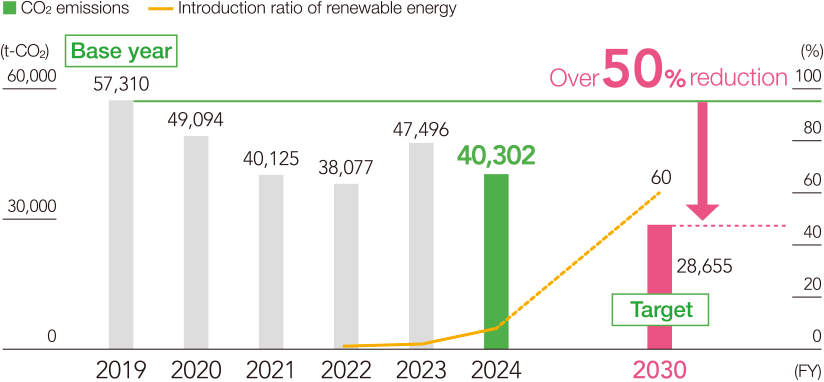
CO2 emissions(non-consolidated)in FY2024 ended up with reduced by 30% compared to FY2019 due to aggressive improvement activities.
Amount of CO2 emissions and renewable energy ratio(non-consolidated)
Case 1 Thorough elimination of waste in the manufacturing workplace
-
In the manufacturing workplace, various measures are being implemented to thoroughly eliminate waste in energy usage.
《Human Motion Sensors》
Currently installed at 950 locations
《Automatic Control of Local Exhaust Systems》
Effect per production line:
Down 9,000 kW/year
Down 2.3 t-CO2/year 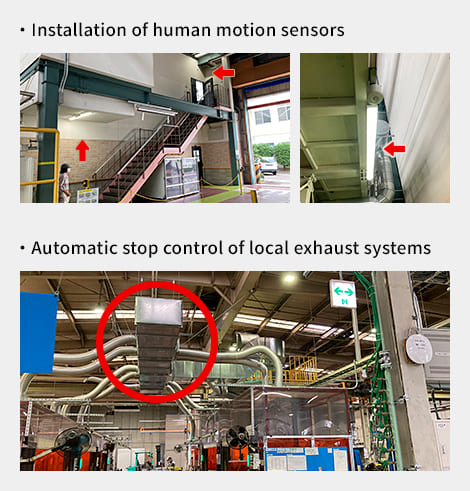
Case 2 Development of CN personnel
- As a foundation for CN activities, we are focusing on the development of CN personnel.
At the Kota Plant (Monozukuri Training Center) and the Tahara Plant, sample equipment showcasing energy-saving examples has been installed.
These include displays comparing the power consumption of fluorescent lamps and LEDs, as well as hands-on devices that demonstrate energy loss caused by different sizes of holes in air hoses.
Through these, employees can “see and touch” to directly experience the impact of CN activities. 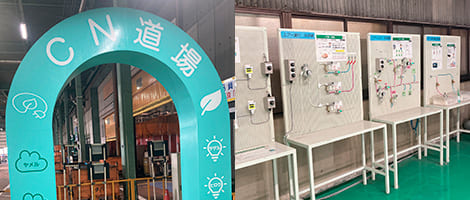
Case 3 Using renewable energy
- As part of our efforts to reduce CO2 emissions, we are introducing renewable energy sources at each of our global sites, primarily through the installation of solar panels. On a non-consolidated basis, our goal is to achieve a 60% renewable energy ratio by 2030.
-
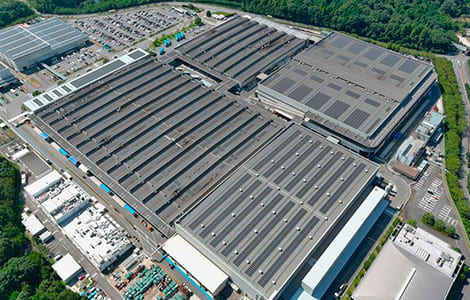
Installation of solar panels at Kota Plant
Major introduction results and plans
| Results | ・2023 | Guangzhou Futaba | Installation of solar panels | 2,355 thousand kWh/year |
|---|---|---|---|---|
| ・2024 | Kota Plant | Installation of solar panels | 3,214 thousand kWh/year | |
| ・2025 | Dongguan Futaba | CO2-free electricity | 1,538 thousand kWh/year | |
| (Plan) | ・2026年 | Mutsumi Plant | Installation of solar panels | 1,541 thousand kWh/year |
| Sumi Plant | Installation of solar panels | 1,466 thousand kWh/year |